Research Interest #1:


The research projects I have been working on include Computational Fluid Dynamics (Hele-Shaw problem), Crystal Growth and Nanostructure Patterning in thin films. These are typical examples of systems driven out of equilibrium. Pattern formation in such systems is  intriguing and challenging. The primary, long-term goal of my research is to develop numerical tools capable of simulating the evolution of these non-equilibrium systems and predicting the evolving morphologies. Of particular interest to me is to design a strategy to precisely control the pattern shape and evolving interfacial instabilities, such as Mullins-Sekerka type instability. I also work with experimentalists to verify my numerical findings.
 

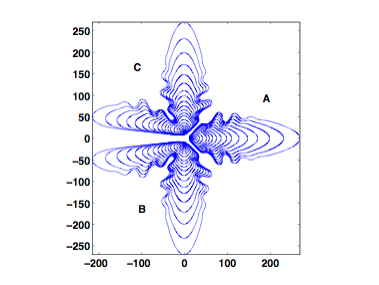
The figure on the left is from S. Li et al. J. Comput. Phys. 225 (2007), 554-567. It shows the growth of an air bubble in a Hele-Shaw cell.  It takes 3 weeks on a P4 computer with CPU 2.2GHz. Total 64k mesh points are used on the interface separating air and oil in the cell.  The ramified fingering pattern is due the Saffman - Taylor instability.

See a movie

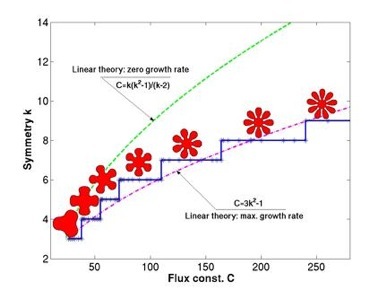
The figure on the left is from S. Li et al. Phys. Rev. Lett. 102 (2009), 174501. It shows the existence of self-similar solutions of the Hele-Shaw problem.  That is, under appropriate flux conditions, there are universal (independent of the initial shapes), symmetric, self-similarly evolving patterns (attractors) in a non-equilibrium system.

See movies

#1, #2#3

Research Interest #3:  To be filled.


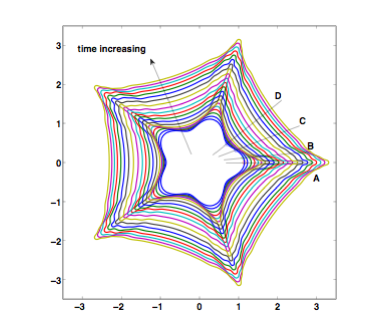
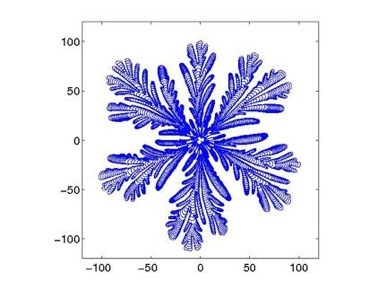
The figure on the left is from S. Li et al. SIAM  J. Sci. Comp.  33 (2011), 3282-3302. It shows the growth of a 5-fold epitaxial island with moderate atomic desorption and kinetic boundary conditions. The problems is posed as a modified Helmholtz (Yukawa) equation with kinetic Gibbs-Thomson boundary conditions.

The figure on the left is from an upcoming paper by my student Amlan Barua (Ph. D. 2012).  It shows the growth of three precipitates in an elastic media. We solve a diffusion problem describing the solid-solid phase transition,  and an elasticity equation describing the contribution of elastic energy. The dendritic structure is due to the applied shear stress at the far-field.

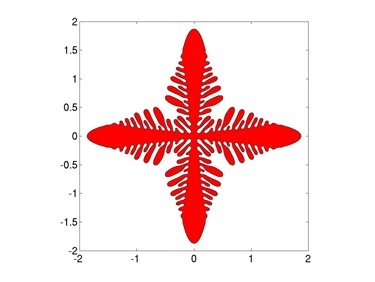
The figure on the left is not published yet. It shows the growth of a crystal (solid-liquid phase transformation).

The 4-fold anisotropic surface energy introduces the tree-like dendritic microstructure.

My collaborators and I are currently using this simple model to figure out the growth mechanism of those side-branches.

Research Interest #2:


Recently I have extended my research to study problems in the biological sciences. I started my research by investigating the dynamics of multicomponent lipid bilayer vesicle membranes. As the principal components of living cells, bilayer membranes play an important role in many cell functions.  Typically, membranes contain multiple lipid components, transmembrane proteins, etc, and hence have complex structures and shapes. As in most biological problems, the shape of these membranes is intimately connected with their biological function. Recent experimental results on vesicle membranes have shown that phase transitions of lipid components may occur and these can lead to dramatic morphology changes of the vesicle (see the recent experiment results on giant unilamellar vesicles (GUVs) by T. Baumgart, S.T. Hess and W.W. Webb, Nature, 425, Oct 23, 2003). This is thought to occur because the different surface lipid components have different surface energies and bending stiffnesses. While there have been several studies of the equilibrium of multicomponent vesicles, the theoretical and computational modeling of vesicle dynamics is still at an early stage.

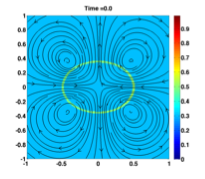
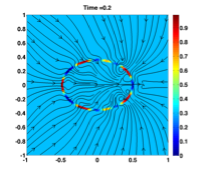
The figure on the left shows four snapshots of the relaxation dynamics of a vesicle in a viscous fluid. The problems includes the Stokes equation to describe the fluid, a Cahn-Hilliard type equation to describe the phase decomposition on the moving bilayer membrane,and a level set equation to capture the interface.  see  S. Li et al.  Comm. Math. Sci.  2012 in press.

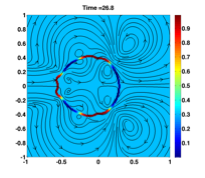
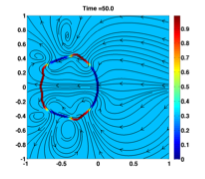
The figure on the left is produce by my student Kai Liu. It shows the effects of phase concentration on the dynamics of a vesicle in an applied extension flow. The negative surface tension  due to an interplay between flow, bending energy and phase energy introduces the wrinkling behavior. The problem is solved using a boundary integral method.